All posts by magister

Corporate meets Academia

simon-newman-official-pic*750xx3800-2138-0-831

GLOCK_19

Bunnies-bunny-rabbits-16437997-1280-800

single hand of drowning man in sea asking for help
Happy group of students sitting at the park talking

This is hard for you because you think of the students as cuddly bunnies, but you can’t. You just have to drown the bunnies … put a Glock to their heads.” – Mr. Simon Newman, previously President of Mount St Mary’s University, a Los Angeles equity fund manager.

By Paul McMullen, 12/17/14
pmcmullen@CatholicReview.org
Twitter@ReviewMcMullen

EMMITSBURG, MD – “Simon Newman told an executive search committee that after nearly three decades “making very rich people richer,” he was looking for a change.

It is not, however, as if the Los Angeles-based financial executive had patterned his life after Gordon Gekko, Hollywood’s 1980s model of greed.

Newman founded software companies, led turnarounds, turned a tidy profit in the European pay-TV market and raised more than $3 billion in equity funding.”

FTC gives online high schools a failing grade

-by Truman Lewis

Little more than diploma mills, FTC says.

Just about every high school kid would like to cut class and study at home, which usually translates to sleeping, texting, and gaming. But that doesn’t mean that online “high schools” offer anything of value.

In fact, the Federal Trade Commission says two online high schools are little more than diploma mills that mislead consumers into thinking they can get a legitimate diploma or GED for as little as $135.

“The defendants took advantage of people who wanted a high school diploma,” said Jessica Rich, Director of the FTC’s Bureau of Consumer Protection. “If a company says you can get a diploma in no time at all or by simply taking an online test, it’s almost certainly a scam.”

In its federal court complaints, the FTC alleges that the “schools” mislead consumers about their legitimacy, using names like West Madison Falls High School, Columbia Northern High School, Stafford High School, and many others.

Documents filed by the FTC in both cases allege that the operations bought a number of website names designed to look like legitimate online high schools and use deceptive metatags with terms like “GED” and “GED online” to bring the bogus sites higher in search rankings. Once consumers arrive at the schools’ sites, they are met with messages that imply that the diplomas offered by the defendants are equivalent to an actual high school diploma.

According to the FTC documents, the “courses” amount to four untimed, unmonitored multiple-choice tests, requiring that students answer 70 percent of each test correctly.

The defendants also mislead consumers with statements about membership in accrediting bodies that do not exist and are creations of the defendants themselves, according to the FTC’s complaints.

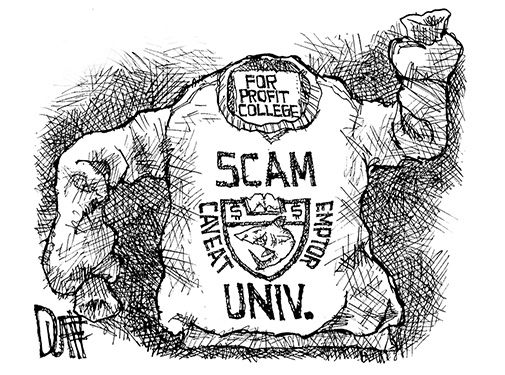
Feds create unit to police for-profit colleges

scamU
-official collegiate sportswear of scamU!!!!

-by Mark Huffman

“The problems students have had with some for-profit school are well documented. Remember Corinthian College?

You don’t have to have a long memory. In September 2014 the U.S. government sued the for-profit college for what it called an illegal predatory lending scheme.

The Consumer Financial Protection Bureau (CFPB) charged that Corinthian lured tens of thousands of students to take out private loans to cover expensive tuition costs by advertising bogus job prospects and career services. To make matters worse, CFPB said Corinthian then used illegal debt collection tactics to strong-arm students into paying back those loans while still in school.

Before it declared bankruptcy and closed less than a year later, thousands of students had borrowed huge sums to attend, with nothing to show for it.

Proactive move
Now, the Department of Education wants to make sure potential train wrecks like Corinthian cross its radar screen before consumers have been harmed. It has announced creation of a Student Aid Enforcement Unit to respond more quickly and efficiently at the first suggestions of trouble.

“When Americans invest their time, money and effort to gain new skills, they have a right to expect they’ll actually get an education that leads to a better life for them and their families,” Acting Secretary of Education John B. King Jr. said in a release. “When that doesn’t happen we all pay the price. So let me be clear: schools looking to cheat students and taxpayers will be held accountable.”

To head up the unit, Robert Kaye is coming over from the Federal Trade Commission (FTC), where he was a top enforcement attorney.

Four divisions
The new unit will have four divisions that will perform special roles. The Investigations Group will be the early warning system, on the lookout for potential misconduct or high-risk activity among higher education institutions so that it can protect federal funding.

The Borrower Defense Group will provide legal support, It will analyze claims and make injury determinations.

The Administrative Actions And Appeals Service Group will impose administrative actions, such as suspending an institution and levying a fine. It will also try to resolve appeals by program participants.

The Clery Group will make sure for-profit colleges comply with the Jeanne Clery Disclosure of Campus Security Policy and Campus Crime Statistics Act, requiring colleges and universities participating in federal financial aid programs to disclose campus crime statistics and security information.”

How your college major influences your attractiveness to lenders

Study finds that certain majors are more creditworthy than others due to lower DTI ratios

Certain majors can often beg the question, “What do you plan to do with that?” A valid question, given that college graduates are now leaving school with an average of $35,000 in student loan debt.

Being saddled with a financial burden that large can make it hard to move forward with other goals. In a Gallup survey, one in four people said they pushed back their timeline for important post-grad milestones like buying a house, a car, or starting a family. Nineteen percent even said their student debt burden was an obstacle to getting married.

To avoid having to delay these important post-grad milestones, it’s crucial to take into account how your major can influence your attractiveness to lenders. So what exactly do lenders consider before deeming an individual financially healthy enough to borrow money?

DTI ratio

According to a report released recently by Credible, debt-to-income (DTI) ratio is a huge factor in determining if an individual is financially healthy enough to be given a loan. And when judging a person’s ability to repay a loan, the lower the DTI the better.

“A person’s DTI can be a yes/no factor for a lender, regardless of the person’s job history,” Credible’s chief executive officer, Stephen Dash tells Bloomberg Business. A DTI of 36% or lower is the “sweet spot,” according to the National Foundation for Credit Counseling (NFCC).

To find the DTI for different majors, Credible looked at the debt load and college major of students in its study sample and added in their estimated car, rent, and credit card payments. It divided its estimates of monthly debt payments into the average monthly income numbers for each degree type. And in what may or may not come as a surprise, psychology doesn’t rank too high on the “creditworthy” graduates list.

Medicine majors
College graduates who studied medicine were in the best shape, financially, to pay back their student loans — much better than those who studied psychology, says Credible.

Degrees in pharmacy, dentistry, and post-graduate medicine had the lowest DTI ratios, the report showed. More than any other majors, these students go on to land salaries that are high enough to offset their student debt, making them loan-worthy.

The majors that made it the hardest to pay back debt include history, education, and psychology. However, if students attend graduate school for one of those subjects, they’ll be able to shift their salary-to-debt ratio more in their favor, thus lowering their DTI ratio says Dash.

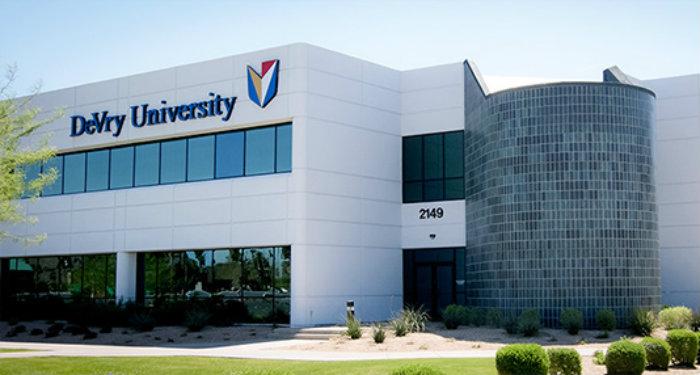
Feds sue DeVry University, charging its ads were deceptive

devry-phoenix_large

Promises that students would find jobs in their field didn’t pan out, FTC suit alleges

DeVry University is the latest for-profit college to run afoul of regulators. The Federal Trade Commission has sued DeVry, alleging that its advertisements deceived consumers about the likelihood that students would find jobs in their fields of study and would earn more than those graduating with bachelor’s degrees from other colleges or universities. DeVry said it will “vigorously fight” the complaint.

“Millions of Americans look to higher education for training that will lead to meaningful employment and good pay,” said FTC Chairwoman Edith Ramirez. “Educational institutions like DeVry owe prospective students the truth about their graduates’ success finding employment in their field of study and the income they can earn.”

In its complaint, the FTC says DeVry claims that 90% of graduates landed jobs in their field within six months — a claim the feds say is deceptive. The suit also alleges DeVry’s claim that its graduates had 15% higher average incomes one year after graduation than the graduates of all other colleges or universities was deceptive.

Melanie of Suamico, Wisconsin, recently recounted her experience with DeVry in a ConsumerAffairs review.

“When I graduated in 2010 with a computer bachelor’s degree I was excited to get my job and start my career. Well I was fooled,” she said. “I got no help from the school (even though I asked for help), I put in hundreds of resumes/apps on my own and got nothing. It is almost like the companies look at the degree that says DeVry on it and they run the opposite direction. I was thinking that I was doing something wrong, but the only thing I did wrong was trust that DeVry would help me get a job.”

DeVry says it will “vigorously fight” the charges. “DeVry University measured the employment and earnings results of its graduates in a sound, rational and transparent basis,” the company said in a prepared statement.

“DeVry Group believes that the FTC’s complaint – filed 40 years after DeVry University began publishing accurate graduate employment statistics – is without a valid legal basis. In addition, the FTC’s complaint contains anecdotal examples that exaggerate the allegations but do not prove them,” DeVry said. “DeVry University measures the employment and earnings results of its graduates on a sound, rational and transparent basis, and has published these results in a consistent manner over the years to provide students meaningful information.”

The FTC’s suit notes that a DeVry television ad showed people in business attire hanging hundreds of “offer letters” on a wall, with a voiceover that said all of the offer letters seen came from just the last year – followed by the 90% claim. The complaint alleges that DeVry counted numerous graduates as working “in their field” when they were not.

That might sound familiar to Gary of Wappingers Falls, N.Y., who said that despite getting his degree and going $62,000 in debt, he has been unable to find a job.

“When I joined the college they stated that they had a 92% placement for graduates within 6 months in their field of study,” he said. “If I could trade my worthless degree for satisfaction of my student debts, I would do it in heartbeat.”

“The college was no help in setting me up with any interviews, they only looked at my resume and made suggestions. I have been on my own since I graduated and have had no luck,” Gary added. “I currently work as a courier to pay my bills, which I could have done without a college degree.”

DOE action

In a related action, the U.S. Department of Education is also taking action against DeVry for its marketing practices. It is providing notice to DeVry that it will be requiring the institution both to stop certain advertising regarding the post-graduation employment outcomes of its students and to take additional steps to ensure that DeVry can substantiate the truthfulness of its post-graduation employment outcomes.

“As required by the law and expected by the public, institutions need to be accurate in their marketing and recruiting to prospective students. And we confirm this truthfulness of advertisements through the backup information schools provide upon request,” said Under Secretary of Education Ted Mitchell. “The Department and the FTC’s related announcements today are the result of much collaboration and cooperation. We are grateful to our partners at the FTC for their hard work and dedication on this matter.”

10% of college grads believe Judge Judy sits on the Supreme Court

That’s today’s “higher education” for ya…

judge-judy-shakes-head-rolls-eyes

This doesn’t surprise me at all. Today’s college students don’t recognize Reagan.

They spend a lot of time studying issues other than history like sex toy workshops.

They get extra credit for not shaving their armpits.

And they want to abandon traditional applications, transcripts and test scores because they are ‘all about privilege and wealth’.

It’s no wonder they can’t even distinguish between a TV judge and an actual judge on the Supreme Court.

Todd Starnes over at Fox News reports that a recent survey showed that nearly ten percent of recent college graduates say that television star Judith Sheindlin is on the Supreme Court.

The American Council of Trustees and Alumni (ACTA) said their survey uncovered a “crisis in American civic education.” The ACTA describes itself as an independent organization committed to academic freedom, excellence and accountability at America’s colleges and universities.

Their findings reveal “that recent college graduates are alarmingly ignorant of America’s history and heritage.”

In it’s reporting on the study, US magazine reports that students could not identify the father of the U.S. Constitution or name one of our First Amendment Rights.

As Mr. Starnes put it, “We’ve gone from the Greatest Generation to the stupidest.”

===================================================

-by Todd Starnes Published January 19, 2016 FoxNews.com

There’s really no way to sugarcoat this, moms and dads – your recent college graduate may be dumber than dirt.

A recent survey showed that nearly ten percent of recent college graduates say that television star Judith Sheindlin is on the Supreme Court.

Yes, friends – our best and brightest seem to think that Judge Judy sits on the highest court in the land.

Parents your child’s B.A. may in fact be a bunch of B.S.

The American Council of Trustees and Alumni said their survey uncovered a “crisis in American civic education.”

The ACTA describes itself as an independent organization committed to academic freedom, excellence and accountability at America’s colleges and universities.

Their findings reveal “that recent college graduates are alarmingly ignorant of America’s history and heritage.”

That could explain why an avowed socialist like Bernie Sanders is giving Hillary Clinton a run for her money.

In it’s reporting on the study US magazine reports that students could not identify the father of the U.S. Constitution or name one of our First Amendment Rights.

And that could explain a why a frightening number of college students support curbing free speech.

Last November Pew Research Center released a survey that showed 40 percent of Americans between the ages of 18 and 34 believe the government should be able to ban any speech that is offensive to minority groups.

For what it’s worth, kids – the “Right to Bear Arms” has nothing to do with limbs or opposable thumbs.

And that brings us to the nearly ten percent of American college kids who think Judge Judy is on the Supreme Court – holding forth with Justice Scalia and Justice Thomas and the one that always falls asleep during President Obama’s speeches.

I suspect some of the young people surveyed have probably been defendants in Judge Judy’s television courtroom.

She said something during one recent episode that relates to our current topic of discussion.

“I’m older – smarter,” she told one of the simpletons. “If you live to be a hundred twenty you’re not gonna be as smart as I am in one finger.”

To be honest with you – that’s really not a bad idea – appointing Judge Judy to the highest court in the land. It seems to me they could use a good dose of commons sense in that court room.

It should really not be that much of a surprise that our taxpayer-funded universities and colleges are churning out boatloads of ignoramuses.

They’ve been too busy coping with micro-aggressions and finding safe spaces and making up new genders.

Sigh.

We’ve gone from the Greatest Generation to the stupidest.

 

ratemystudents.com

While this domain is still held by those in the academy, it is dormant. When first launched in 2005, it persisted in ostensible use until 2011, the “sleeping giant”, Japanese would say. Mature scholars realize the pettiness, and fruitlessness of it all in the absence of civility, patience, charity, good humor, and benefit-of-the-doubt we constantly owe to our superiors and elders. However, the following does make its salient argument well, imho:

http://www.rci.rutgers.edu/~wcd/ratestud.html

Can Universities Create the “New Renaissance Man” Tech Firms Need?

Da_Vinci_Vitruve_Luc_Viatour

As Leonardo da Vinci applied his intricate knowledge of human anatomy to create timeless art, so 21st-century technology developers must combine technical skill with multi-disciplinary insight.

12/14/15
-by Denis Nekipelov, Associate Professor of Economics and Computer Science at the University of Virginia.

What skills do you need to get hired by top tech firms today?

As a professor of economics and computer science, I hear this question more than any other from students, and it’s the top question I ask of colleagues working at today’s major tech firms. Their answer is simple and daunting: “We want the full package.”
Leading-edge tech companies are defined by consumer-facing products and internal “startup-style” culture. Thriving in that environment requires knowledge of data sciences and social sciences. Graduates interested in tech will certainly need practical knowledge, but many will also need abstract theory. They must be able to appreciate the details and the big picture, to code and to codify.

If you look at any category in an app store, you see top mobile apps that get thousands of downloads and reviews and a very long tail of apps that barely get any consumer attention. Those forgotten apps have failed to appeal to enough people, often because developers did not analyze demand accurately or strategically monetize and market the product. Knowledge of human behavior — supported by science — can predict the success of digital products. Such knowledge comes in large part from the social sciences and humanities.

For example, a graduate who understands fundamental concepts like the Nash equilibrium — a game-theory concept holding that players’ strategies are based not on logic alone but on knowledge of other players — will better understand how consumers behave. A graduate who studied linguistics will be better equipped to develop artificial intelligence-based applications, which rely on a deep understanding of language. A graduate who studied music or art will be ready to design more compelling virtual environments.

This is not to say, though, that technology firms need purely social scientists. Tech firms’ startup culture means that new IT products, even larger ones like Microsoft Windows or Mac OS, are developed by very small teams. There is no room for a theorizing economist or a sociologist. The development process requires constant testing and changes to source code. The urgency increases when the product is first released: Early bugs must be detected and instantly fixed. Every team member needs to understand the technology at a minute level.

Consequently, the most compelling hire will be at once an engineer and a social scientist — a “New Renaissance Man.” As Leonardo da Vinci applied his intricate knowledge of human anatomy to create timeless art, so 21st-century technology developers must combine technical skill with multi-disciplinary insight. These employees are the “full package” — social scientists who can articulate principles of consumer behavior and manage complex computing infrastructure. They are computer scientists and engineers who can use economic models and sociology theory to accurately analyze, prove and meet consumer demand.

As an educator, I have to admit that the American higher education system is still far from developing that “New Renaissance Man.” Too often, the education community interprets demand for integrated fundamental knowledge as demand for number-crunching skills combined with some literacy in economics or business. This has led to a proliferation of “business analytics” and “data analytics” concentrations that focus narrowly on technical competence. This shortsighted strategy could lead to the development of skills that become antiquated before students graduate, as technology responds rapidly to changing demand.

The most employable graduates will have knowledge beyond specific infrastructure, programming language or statistical software. Their knowledge will be fundamental.
My advice to undergraduates would not be to take a class in Python, but instead take a class in the theory of algorithms. Similarly, do not take a class in online auctions; instead, take a class in game theory. Many undergraduates, especially those who find jobs with the Googles and Microsofts of today, already follow this strategy. However, they need more institutional support.

My advice to institutions is to develop more integrative interdisciplinary programs to adequately address 21st-century industry demand for talent. At the new Data Sciences Institute at the University of Virginia, we have found success in creating centers that foster interdisciplinary collaboration — one focuses on big data ethics, law and policy, another on how data science is transforming knowledge. We have also used reading groups and lecture series to gather faculty, students and private sector leaders in technology, economics, public policy and other key areas. We want students to not only develop and create technology, but also thoughtfully discuss its implications and accurately predict its outcomes, with sound social science backing up their conclusions.

Such efforts should be but the beginning, as the new landscape of the technology sector calls for increasing involvement of social science in places previously exclusive to engineering and computer science. Technology is changing at a rapid pace, and universities must prepare a skilled workforce that can easily adapt to even the most dizzying rate of change.